Introduction
As the digital revolution eased the lives of people by merging the range of sectors from banking, shopping, business, organizations, and government systems into online platforms. As a result, there is an increase in cyberthreats like hacking, ransomware, and data breaches. Therefore, organizations and businesses need professionals who can monitor systems 24/7 and detect and remove cyberthreats. Here’s the question that arises: how to prevent these cyberthreats? In this way, the CyberOps Associate certification serves as an excellent entry-level pathway into the cybersecurity field.
For individuals who are eager to start a career in cybersecurity operations, Cisco Systems offers the Cisco Certified CyberOps Associate certification, an entry-level cybersecurity credential. In this blog, we will explain the certification, what you can learn from it, and why it can be a good place to start if you want to work in cybersecurity.
Let’s start a blog:

What is a CyberOps Associate?
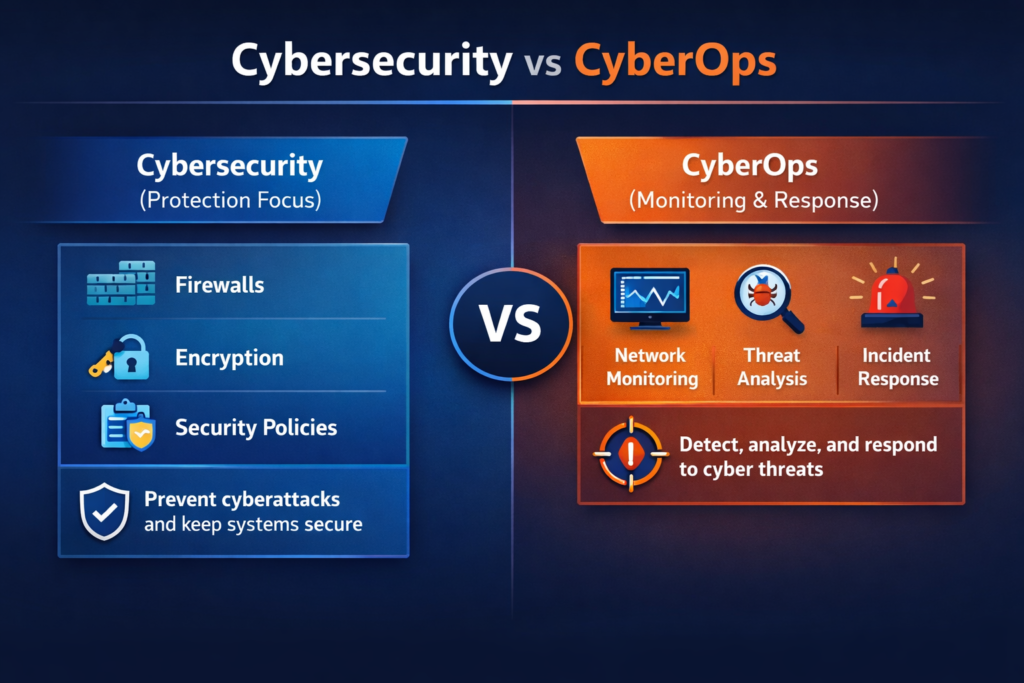
“CyberOps” stands for Cybersecurity Operations. In simple terms, it refers to the day-to-day activities that security professionals perform to keep networks, devices, and systems safe and secure from cyberattacks. Specifically, it involves using defensive strategies and tools within a Security Operations Center (SOC).
Typically, professionals working in CyberOps usually work in a security operations center (SOC). A SOC is a place where cybersecurity professionals monitor systems every time to analyze and detect malicious activities and hinder attacks before they create damage.
Cybersecurity Vs. CyberOps
Purpose Of the Cisco Cyberops Associate Certification
The goal of this certification is to help learners understand:
- How do cyber attacks happen?
- How do attackers try to break into systems?
- How do organizations monitor their networks?
- How to identify suspicious activity?
- How to respond to security incidents?
Key Areas Covered in Cybercops Associate Certification
The Cisco Certified CyberOps Associate program by Cisco Systems focuses on the core knowledge required for cybersecurity operations and security monitoring roles.
Security Fundamentals
First of all, you will learn the basic ideas behind cybersecurity, including:
- Types of cyber threats
- Malware and phishing attacks
- Security policies and frameworks
- The importance of confidentiality, integrity, and availability (CIA).
However, these help you understand why security is important and how threats work.
Networking Basics for Security
Since cyberattacks often target networks, this section teaches the following:
- IP addressing and network communication
- Common network protocols
- Firewalls and intrusion detection systems
- Network monitoring tools
As a result, you will recognize abnormal traffic patterns that might indicate an attack.
Security Monitoring and Threat Detection
In addition, you learn how to:
- Read security logs
- Use monitoring tools
- Identify unusual behavior.
- Detect possible attacks early
Security analysts often analyze logs and alerts to determine if something dangerous is happening.
Incident Response
Once a threat is detected, the next step is response. You will learn:
- Read security logs
- Use monitoring tools
- Identify unusual behavior.
- Detect possible attacks early
Basic Digital Forensics
Finally, you will explore digital investigation techniques such as
- Log analysis
- Evidence collection
- Tracking attacker activity
- Understanding how breaches occur
Thus, this will help future attacks.
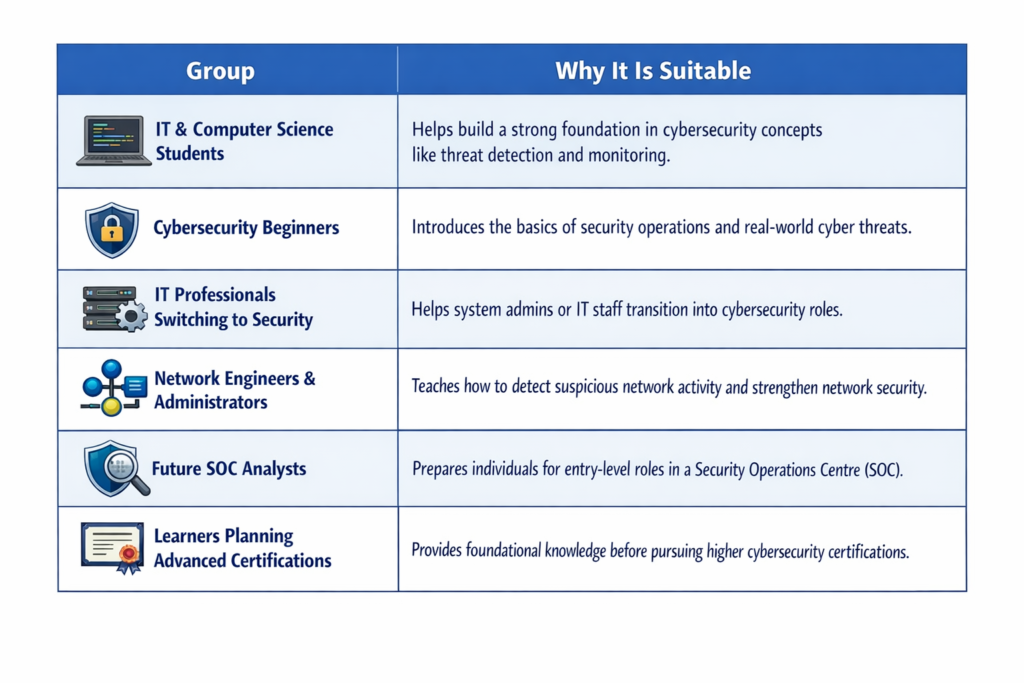
Who Should Pursue the Cisco Cybercops Associate Certification?
Career Opportunities After Cyberops Associate Certifications
SOC Analyst (Levels 1&2):
In a SOC, analysts monitor networks in a security operations center. They also check alerts for suspicious activity to quickly identify possible security threats.
Cybersecurity Analyst:
Cybersecurity analysts help to protect an organization’s systems and data by reviewing security events and supporting security measures.
Security Operations Technician:
Security Operations Technicians support the security team by maintaining security tools. which helps respond to basic cyber incidents.
Junior Threat Intelligence Analyst:
Junior threat intelligence analysts study cyber threat information to help organizations understand and prepare for possible attacks.
Cyberops Associate Vs Other Cybersecurity Certifications
- CyberOps Associate: Best for Defensive security (SOC analyst)
- CompTIA Security+: To learn Cybersecurity basics (beginner level)
- Certified Ethical Hacking (CEH): Best for Offensive security (ethical hacking)
CISCO CYBEROPS EXAMS DETAILS
- Exam Code – Cisco 200-201 CBROPS is the code for the exam.
- Exam Duration – 120 minutes is the time required to complete your exams.
- Question Type—The exam IS conducted in multiple-choice (Macq’s) form.
CONCLUSION
The Cisco CyberOps Associate certification is a strong starting point for anyone looking to enter the cybersecurity field, especially in SOC roles. It builds essential skills in threat detection, monitoring, and incident response. If you want to begin your journey with proper guidance and hands-on training, you can enroll in the CyberOps Associate course at Adan IT Center and take your first step toward a successful cybersecurity career.
Frequently Asked Questions (FAQS)
What is Cisco CyberOps Associate?
These are the day-to-day activities that security professionals perform to keep networks, devices, and systems safe and secure against cyberattacks by covering strategies and using defensive tools in a security operation center (SOC).
Is the CyberOps Associate good for beginners?
Yes! CyberOps is the entry-level certification that covers the fundamentals of cybersecurity specialized for SOC, which paves the way for advanced-level certifications like Certified Ethical Hacker (CEH) and Network Security Professional.
How difficult is the CyberOps Associate exam?
CyberOps exams are challenging for beginners who lack the basic networking and security knowledge and are unaware of SOC tools for threat management. Following study guidelines, lab practice, and watching online tutorials can help you pass the exam on your first attempt.
What jobs can I get after CyberOps Associate?
You can be a security operation center (SOC) analyst, cybersecurity analyst, security operation technician, or junior threat intelligence analyst.
How long does it take to prepare?
Almost 60-80 hours is the required time to prepare for the exam.
How to Pass the CyberOps Associate Certification?
Here is the complete step-by-step roadmap to pass the cyberops certification:
- Learn networking basics
- Study cybersecurity fundamentals
- Practice SOC tools
- Analyse logs and packets
- Take mock exams